
September 11, 2001: 25 years later
A quarter century later, remembering the day that changed America forever
Ground Zero in New York City is exactly 1,498.53 miles from the Shackelford County Courthouse, but 25 years ago this week, it did not feel that far away.
On Tuesday, Sept. 11, 2001, terrorists hijacked four passenger airplanes, flying two into the World Trade Center in New York City and another into the Pentagon outside Washington, D.C. Passengers fought back aboard the fourth plane before it crashed in a field in Pennsylvania. By the end of the morning, the two 110-story towers of the World Trade Center had collapsed and nearly 3,000 people had been killed.
For those old enough to remember Sept. 11, most can still tell you where they were when they heard the news. But a quarter century has passed, and an entire generation now knows the attacks only as history. That makes retelling what happened, and preserving the firsthand accounts of those who experienced it, even more important.
The Morning America
Was Attacked
The attacks were carried out by 19 members of al-Qaeda, the terrorist organization led by Osama bin Laden. The men boarded four commercial flights on the East Coast that morning and took control of the airplanes after takeoff.
At 8:46 a.m. Eastern time, American Airlines Flight 11 crashed into the North Tower of the World Trade Center. At first there was confusion over what had happened, but 17 minutes later, United Airlines Flight 175 struck the South Tower. Television cameras were already pointed toward the buildings, allowing millions of Americans to watch the second plane hit live. It was now clear the United States was under attack.
At 9:37 a.m., American Airlines Flight 77 crashed into the Pentagon outside Washington, killing everyone aboard and 125 people inside. Government buildings were evacuated and airplanes across the country were ordered to land as officials tried to determine whether more attacks were coming.
In New York, thousands were trying to escape the World Trade Center while firefighters, police officers and other emergency workers rushed toward the burning towers. At 9:59 a.m., the South Tower collapsed. The North Tower followed at 10:28 a.m.
The fourth airplane, United Airlines Flight 93, never reached its intended target. Passengers had learned through phone calls what had happened in New York and Washington and realized their plane was also going to be used as a weapon. They fought back against the hijackers before the plane crashed near Shanksville, Pennsylvania, at 10:03 a.m. All 40 passengers and crew members were killed, but their actions prevented the plane from reaching Washington, where investigators believe the U.S. Capitol was the likely target.
Only 102 minutes separated the first plane striking the North Tower and its collapse. The attacks claimed 2,977 victims and changed the United States forever.
Albany teacher in
New York
One Albany resident who experienced those hours from New York City was longtime Albany teacher Judy Compton. This week, Compton sat down with The Albany News to recount her experience in the city 25 years ago and the memories that remain with her today.
Compton had traveled to New York with her daughter Melissa and son-in-law Toby Neugebauer for a short trip before her retirement after more than 30 years of teaching. They arrived Sept. 10, and one of their first stops was the World Trade Center.
Melissa wanted to take her mother to the top of one of the towers to see the Statue of Liberty, but they were told it was too cloudy to see much. While there, Compton remembers suddenly feeling uneasy, a feeling she believes was the Holy Spirit warning her that something was not right. She turned to Melissa and asked whether the World Trade Center had been bombed before. Melissa told her it had.
“Let’s get out of here,” Compton remembers telling her. “I don’t like this place.”
The next morning, Compton was having coffee in a breakfast area of the Waldorf Astoria when a woman she had met the previous day approached while using a telephone. Compton vividly remembers what the woman said.
“This is war.”
Compton found Melissa, and they soon returned to their room and watched the news on television. Toby had gone out to get a newspaper and had a business meeting that morning, but after the second plane struck the World Trade Center, the meeting ended and he returned to the hotel.
As New York shut down around them, hotel services became limited and transportation was disrupted. Compton remembers people walking the streets in shock, including one man who seemed almost numb to what was happening.
She also remembers seeing a tank and military personnel on the streets and asking Toby why they were there.
“Judy, you are in a war zone,” he told her.
Her thoughts quickly turned toward home. Compton worried that Dyess Air Force Base might become a target and thought about her students back in Albany and whether they were safe.
Getting home proved difficult with commercial air traffic grounded. Toby eventually arranged for a private plane from Lubbock to pick them up at an airport in Connecticut. They found a driver to take them out of New York, and Albany resident Pati Jones, who was also stranded in the area, joined the flight home along with several others.
Even 25 years later, Compton said the memories of those days have not faded.
“It does,” she said when asked if it still feels like yesterday. “It truly does.”
The Attacks Hit Close to Home
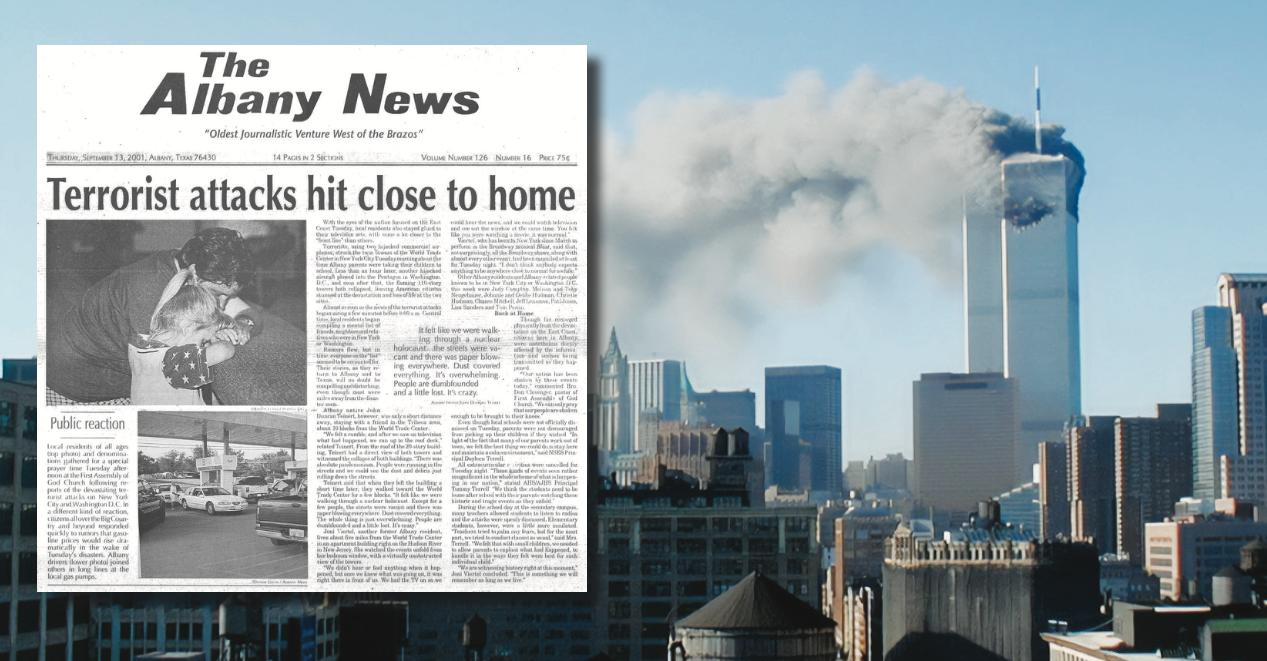
Compton was not the only person with Albany ties close to the attacks. Two days later, the Sept. 13, 2001 edition of The Albany News carried the front page headline “Terrorist attacks hit close to home,” documenting how the events had reached people from this community.
Albany native John Duncan Teinert was staying with a friend in Tribeca, about 10 blocks from the World Trade Center.
“We felt a rumble; and after we saw on television what had happened, we ran up to the roof deck,” Teinert told The Albany News that week.
From the roof of the 20-story building, Teinert had a direct view of both towers and watched them collapse.
“There was absolute pandemonium,” he said. “People were running in the streets and we could see the dust and debris just rolling down the streets.”
A short time later, Teinert and others walked several blocks toward the World Trade Center.
“It felt like we were walking through a nuclear holocaust,” he said. “Except for a few people, the streets were vacant and there was paper blowing everywhere. Dust covered everything. The whole thing is just overwhelming. People are dumbfounded and a little lost. It’s crazy.”
Former Albany resident Joni Viertel was across the Hudson River in New Jersey, where she was living while performing in the Broadway musical “Blast.” From her apartment, Viertel had an almost unobstructed view of the towers and watched the events unfold while following the news on television.
“You felt like you were watching a movie; it was surreal,” she told The Albany News at the time.
Back home, Albany residents tried to reach friends and relatives in New York and Washington. Albany schools remained open, although parents could pick up their children, and extracurricular activities were canceled. Older students followed news reports and discussed what was happening, while elementary teachers attempted to maintain a normal school day.
Viertel summed up the moment in the newspaper that week.
“We are witnessing history right at this moment,” she said. “This is something we will remember as long as we live.”
Twenty-Five Years Later
The attacks led to a nearly 10-year search for Osama bin Laden. American intelligence eventually tracked one of his trusted couriers to a secured compound in Abbottabad, Pakistan, where officials believed bin Laden was hiding.
President Barack Obama authorized a secret mission known as Operation Neptune Spear, and on May 2, 2011, U.S. special operations forces raided the compound. One of their helicopters crash-landed during the operation, but the team continued into the compound and found bin Laden on an upper floor of the main house, where he was killed.
Nearly a decade after Sept. 11, the man who led the organization responsible for the attacks had been found.
Now another 15 years have passed.
The children who sat in Albany classrooms on Sept. 11, 2001 are adults, many with children of their own. The memories of Judy Compton in New York, John Duncan Teinert watching the towers collapse and Joni Viertel looking across the Hudson River are no longer simply memories of a current event. They are becoming part of history.
That is why, 25 years later, the story is still worth telling. Sept. 11 changed the country, but understanding that history requires more than remembering a date. It requires remembering what happened, those who were lost and the stories of the people who lived through it.
A quarter century has passed, but it will never be long enough to forget.
