
Shackelford County’s only known meteorite verified near Lueders
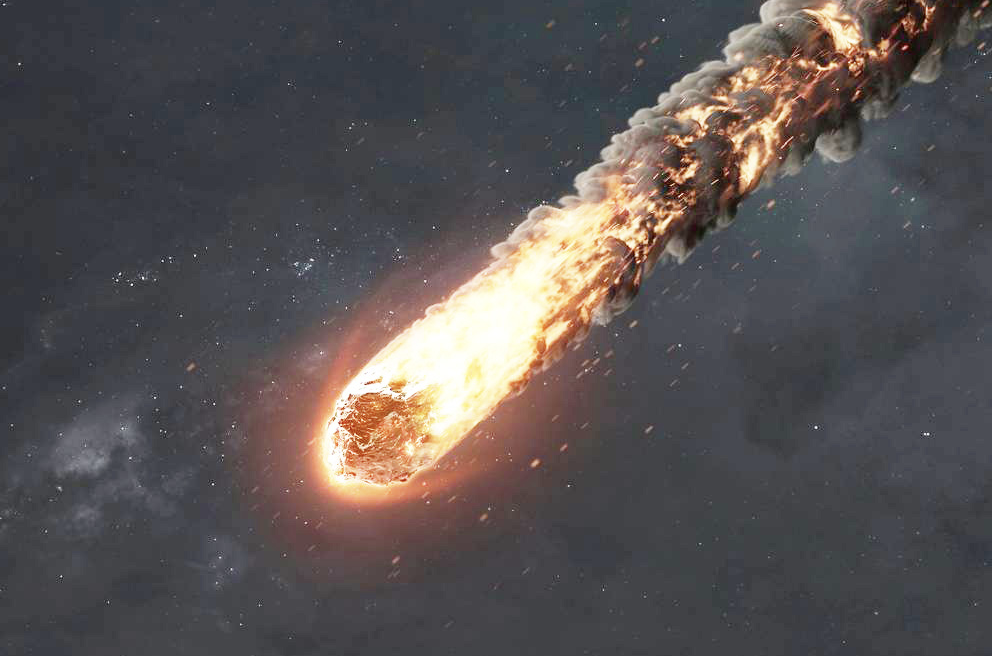
Wait… You thought this was breaking news? Not quite.
Last month, headlines lit up with talk of asteroid 2024 YR4—a space rock initially thought to have a 3.1% chance of colliding with Earth in December 2032. That’s a pretty high number in asteroid terms, and for a brief moment, scientists and sky-watchers alike wondered if we’d have a real-life disaster movie on our hands. But before anyone could start writing scripts for Armageddon 2, additional observations downgraded the risk, and NASA eventually ruled out an Earth impact. The asteroid might still hit the Moon (1.7% chance), but for now, we can all breathe easy.
All this talk of space rocks got us thinking about Shackelford County’s very own meteorite—the only one ever confirmed to have landed here. And no, it didn’t just crash down last week. In fact, this little piece of the cosmos was dug up near Lueders back in 1973 by Sandra and Bobby Reves. Unlike 2024 YR4, which astronomers have been tracking for mere months, this meteorite spent decades sitting unnoticed in a field before getting the recognition it deserved.
So while this latest asteroid turned out to be a whole lot of nothing (unless you’re worried about the Moon), Shackelford County does have its own claim to space history. Here’s a look back at the time our county got a personal delivery from the cosmos—no telescope required.
-David H. Waller
Albany News article from March 7, 1996
By Pat Lidia Jones
In 1973, Sandra and Bobby Reves uncovered an unusual “rock” as they cleared and terraced a field on their farm in western Shackelford County near Lueders.
A small piece of the strange-looking object, which the couple suspected to be a meteorite, was sent to a lab at Hardin-Simmons University in Abilene. However, through a mishap, the sample was lost.
Because of this, the Reves put away their 60-pound field stone, after a decision not to place it in further jeopardy.
It wasn’t until over 20 years went by, through a chance reading of an article in Texas Farmer-Stockman Magazine on meteorites that their interest and curiosity about their find was renewed.
Another chunk was knocked off and sent in to be examined. This time C.F. Lewis of Arizona State University and a number of private meteorite dealers confirmed that the Reves did indeed have a meteorite. The couple still wanted more and better verification. The A.S.U. scientist thought it to be a new find, but others theorized that the Lueders stone might have shared similarities with a meteorite found near Odessa.
In March, 1994, the Shackelford County couple took the meteorite to the Geology Department of Texas Christian University, where Reves and Prof. A.J. Ehlmann, cut sample pieces. After extensive tests and consultations, a paper describing the meteorite was prepared by Ehlmann, along with T.J. McCoy of NASA, Johnson Space Center in Houston; G.K. Bendix, Hawaii Institute of Geophysics and Planetology at the University of Hawaii; R. Keil, Hawaii Center for Volcanology; and J. Wasson, Institute of Geophysics and Planetary Physics, U.C.L.A. at Los Angeles, California.
The paper is a highly technical scientific treatise and is expected to be published in an upcoming issue of Meteorites Journal. Anyone who wishes to see a copy of the article is invited to make arrangements with The Albany News where it is on file.
“Shackelford County is about to become known throughout the world as the home of this meteorite,” said Sandra Reves. “It has really been interesting to be involved with a project like this.”
The couple also related that the confirmed meteorite will be listed in a world-wide catalog of meteorites. The only other known finds in the West Central Texas area are in Ballinger and Haskell.
The tested pieces of the meteorite are now in the research collection of the University of Hawaii at Manoa, and a sample was given to TCU to add to its collection.
The team of scientists also examined polished thin sections of the Odessa and Ballinger meteorites for a pairing study.
Comparisons indicated that the composition of the Lueders metal is dramatically different from the widely-distributed Odessa meteorite. The differences rule out a pairing of these two meteorites.
“Meteorites are usually made up of iron and silicate. Ours is mostly iron and has deteriorated some since we first found it,” explained Bobby. “It is, in effect, rusting away very slowly due to oxidation.”
Reves was a chemistry major at Hardin-Simmons University, giving him insight into the rare find that other laymen probably wouldn’t have.
The Lueders, Shackelford County, Texas sample is remarkably similar in its metal composition to Landes. Interestingly, Landes is in West Virginia; the geographic distance seems to preclude pairing. The paper mentions, however, that pieces of meteorites from a variety of locations were widely distributed by Native Americans and by wagon trains of settlers.
The now completely verified and authenticated Lueders/Shackelford County meteorite is classified as a silicate-bearing IAB-AN Iron. A range of processes were involved in the formation of silicate-bearing irons. It is indicated that temperatures exceeded 1000 degrees C, and the veining represents localized melting at or slightly above this temperature.
Though the meteorite is called Lueders throughout the dissertation, Sandra and Bobby Reves found it in a field they were clearing approximately two miles inside the Shackelford County line.
