
Multiples run in the family at NSES
By Lynsi Musselman
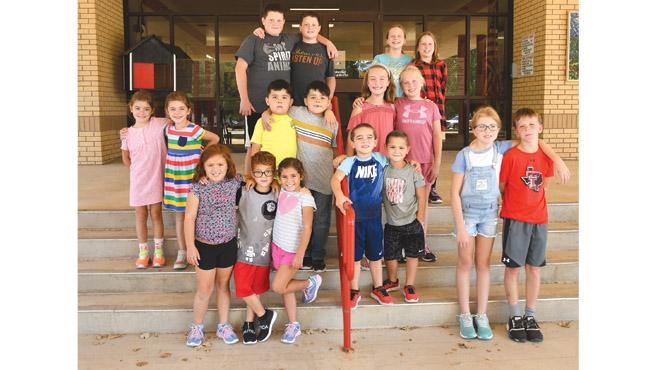
Maybe it is in the water, or maybe it is just coincidence, but the number of residents that are one of a pair of twins is unusually high for a town the size of Albany.
Generationally, Albany has seen several sets of twins grow up and pass through, but this year at Nancy Smith Elementary School 17 children out of 280 are multiples.
Not only are there seven pairs of twins, but there is also a set of triplets, which makes the percentage of multiples at NSES double the national average.
What makes this number even more unusual is that one set of identical twins have preschool siblings 22 months younger that are fraternal twins.
When parents Ashley and Ben Agee found out they were having identical twin girls , Lottie and Pippi, after already having an older daughter and son, they were surprised.
“The pregnancy with the girls was difficult because they were mono-di identical twins,” Ashley explained.
Monochorionic-Diamniotic Identical Twins, also called mono-di twins, are rare, with an occurrence of 1 in 35,000 to 1 in 60,000, and require aggressive fetal monitoring.
Ben said the twin girls, Lottie and Pippi, developed twin to twin transfusion syndrome (TTTS) in utero and had to be treated by specialists in Houston.
Ashley said when she found out she was pregnant a fourth time, she immediately knew it was twins again by the way she felt.
“Ben and everyone else said there is no way it is twins again,” she said. “On our first doctor’s visit, I told the sonogram tech our story about the girls. She started the sonogram and yelled out when she saw two babies!”
Ashley was relieved that the twin boys, Mack and Luke, were fraternal, and she knew it would be a less stressful pregnancy.
“I wake up shocked every day,” Ben said. “Our maternal-fetal medicine specialist told us the odds of having two sets of twins back to back is one in 75,000.”
Ben said that each child has his or her own personality, but the trick to raising twins is to treat them as individuals and not always as a pair.
“They have just as many differences as they do similarities,” Ben explained.
Lottie and Pippi are currently enrolled in first grade and Mack and Luke will be in kindergarten at NSES next year.
The Agees also have Annie in fifth grade and Emmett in third grade.
The first grade class at NSES also has a set of triplets, Kelsey, Kayley, and Conner Carrion.
The triplets’ mom, Jillian Lucas, said that when she went in for a routine sonogram after two uneventful previous pregnancies, it was just another appointment that changed quickly.
“Just a few seconds after the technician started, she turned the monitor away and told me to brace myself,” Lucas added.
She said when she left the doctor’s office she just drove around aimlessly for awhile.
According to the CDC, only 3,400 triplets were born in the U.S. in 2018, out of 3,791,712 births.
The Carrion triplets will be seven in November and their mother said they could not all three be more different in looks and in personality.
“It is hard not to treat the girls as a group and Conner as one,” Lucas said. “The girls are together in one first grade class and Conner is in the other first grade class.”
She explained that the triplets feel like it is abnormal for everyone not to be part of a set.
“The girls are excited to have a set of twin girls in their class this year,” Lucas added.
She said that although all three demand independence, they rely on each other and hold each other accountable. They have what they call “the triplets pact.”
“The triplets were easier babies and are still easier than my older boys that are singles,” Lucas added.
The mother of six also has Cooper in third grade, Carter in fourth grade, and an older adopted son.
NSES school secretary Stephanie Gleitz not only gets a front row seat to see all the multiples at school, but she has a set of her own.
Avery and Hailey Gleitz are fourth grade fraternal girl twins, born one minute apart.
Gleitz said the girls are night and day different in looks and personality. One is a tomboy and one is very “girly.”
“Despite the twins’ differences, they are each other’s best friends, even though they might not admit it,” Gleitz explained.
Other NSES multiples
NSES also has twins Oakan and Oxton Hawkins in kindergarten, Andre and Azrael Rosales in second grade, Blake and Keeley Britting in fourth grade, and sixth graders Rylee and Kylee Bennett, and Rowdy and Levi New.
“It is amazing how many multiples are at the elementary school,” Gleitz said. “We love having them all here.”
Several other students at NSES have siblings that are twins, parents that are twins, even grandparents that are twins living in the community.
Not only are there a large number of twins in one elementary school and one small town, but the type of multiples makes the amount even more uncommon.
Statistics
Texas ranks 39 out of 51 for number of twins born in the U.S. each year.
According to genetic researchers, fraternal twins are genetic from the mother’s side, but other factors can result in fraternal twins. Identical twins happen at random.
The conclusion of the final data collected in 2018, there was a four percent decline in multiple births after a steady increase over the last three decades.
