
From the Editor’s Desk: A leader who left a mark
Living in the DFW area for more than 10 years, I was an avid listener of The Ticket. If you have lived there and you are any kind of sports fan at all, you probably were too. It was one of those things that became part of the daily routine. You got in the car, headed to work, and The Ticket was already on. My favorite show was always The Musers with Craig Miller, George Dunham and Gordon Keith.
Recently, the three of them stepped into the podcast world with The Musers: The Podcast, which, I have to say, is about the most straightforward podcast name of all time, but I think that was the point.
On a recent episode, they talked about the people who played major roles in shaping who you are. Not the easy answers like your parents or grandparents or siblings, but the people you meet along the way who influence you deeply and leave a mark on your life. A teacher. A coach. A pastor. A boss. A friend. Somebody God puts in your path at the right time, who helps shape the person you become.
That conversation got me thinking about who those people have been in my own life.
I have been blessed with many. I had wonderful teachers growing up, and I could write future columns about several of them. There were people who encouraged me, challenged me and believed in me before I fully believed in myself. But when I really stopped and thought about the question, one person came to mind almost immediately.
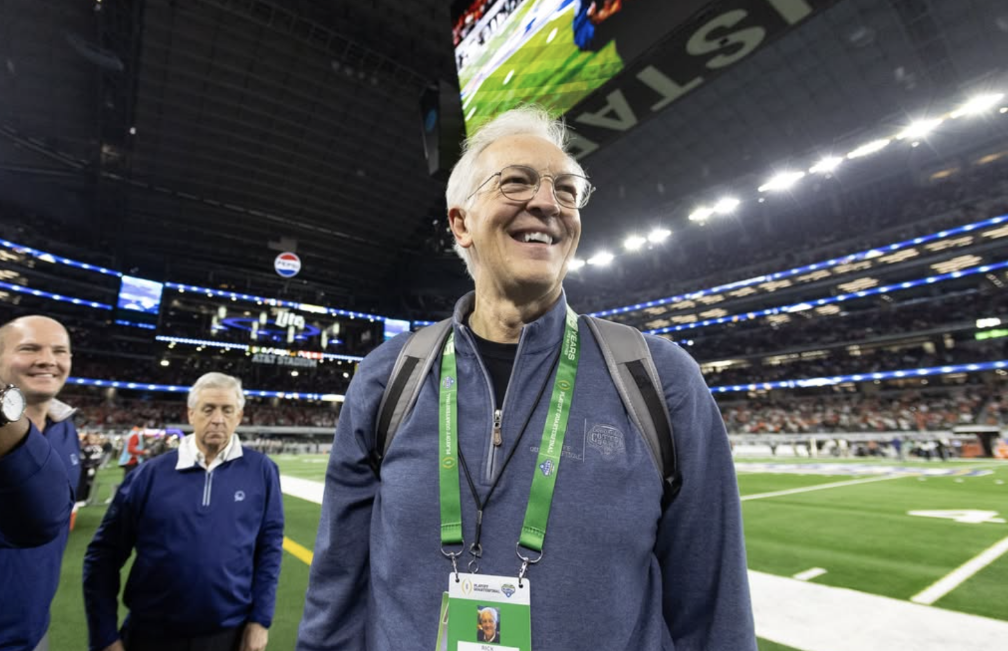
Rick Baker.
Now, most people in Albany probably do not know Rick, and that is understandable. Some of our subscribers in the DFW area may have heard his name or met him through the years. But in the college football world, and especially in North Texas, Rick Baker is a giant.
His career speaks for itself. Rick spent 38 years with the Cotton Bowl Athletic Association, first joining the staff in 1988 as Director of Marketing, later becoming Executive Director in 1992, and eventually serving as President and CEO. Over nearly four decades, he helped guide the Cotton Bowl into one of the premier postseason events in all of college football.
That is not some small accomplishment.
During Rick’s time, the Cotton Bowl grew in ways that once would have seemed impossible. He helped oversee major broadcast partnerships, conference relationships, sponsorships, the move to AT&T Stadium and the game’s place in the College Football Playoff. Under his leadership, the Cotton Bowl did not simply remain relevant, it became one of the most respected bowl experiences in the country.
And that word, experience, is important.
Because if you know Rick Baker, you know the game itself was only part of what mattered to him. Of course he wanted a great game. Of course he wanted strong teams and a big stage and unforgettable moments on the field. But what he really cared about, maybe more than anything, was making sure everyone involved had a first-class experience from start to finish.
He cared about where the teams stayed. He cared about the hospitality rooms. He cared about the gifts. He cared about the events, the transportation, the practices, the schedules, the meals, the details nobody in the stands would ever know about. He wanted the athletes, coaches, administrators and guests to leave saying, “That was as good as it gets.”
And because of him, they all did.
Fans may think they want the Rose Bowl or the Sugar Bowl or the Orange Bowl, and those are all great traditions. But the teams and the people behind the scenes knew what the best trip in the business was. They wanted to be in Arlington for the Cotton Bowl. That reputation was built very intentionally, and Rick Baker is the main reason why.
As impressive as all of that is, the real reason I wanted to write this is not because Rick had a storied career. It is because of the kind of man he is.
Rick is originally from upstate New York, so when he first met me and learned I was from Albany, he got a little excited. I had to correct him, of course, and let him know I was from the better Albany, the one in Texas. I do not know that he fully agreed, but I still stand by that statement.
From the very first day I met him, Rick was as kind, warm and genuine as he could possibly be. He did not treat me like I was just some young staff member trying to find his footing. He treated me like I mattered. He wanted to know who I was, where I came from and what made me tick. That may sound simple, but it is not. A lot of people in leadership positions are nice enough, but not everybody is truly interested in people. Rick was.
And he was that way with everyone.
He is a perfectionist, but in the healthiest and most productive way. He wanted things done right. He wanted details handled. He wanted meetings to be prepared, plans to be thought through and events to go off without a hitch. Some people hear the word perfectionist and think of someone impossible to please. That was not Rick. He simply believed that if you are going to do something, you ought to do it well.
That rubbed off on me more than I realized at the time.
To this day, I still think about the way he approached work. He taught me that excellence is usually not one giant leap. It is a thousand little things done carefully. It is showing up prepared. It is not cutting corners. It is caring enough to go back and fix something that most people would never notice. It is trying to improve by one percent every year, because over time those one-percent improvements become something substantial.
That mindset has stayed with me long after I left the Cotton Bowl.
Rick also loved staff meetings. And I mean LOVED them. He liked getting everybody in a room and talking through things, from the smallest detail to the biggest event. He wanted every angle considered. He wanted people heard. He wanted to make sure nothing had been overlooked.
And within those meetings came one of my favorite Rick Baker quirks.
He would often say, “Just talking out loud here,” when the real saying is, “Just thinking out loud.” He said it all the time, and every time he did, I would quietly grin and glance around the room because I knew others had caught it too. It was such a harmless little mix-up, but it became one of those small things that made him even more endearing.
Now, that is not to say Rick never got serious. He absolutely did.
In fact, I only saw him truly mad one time, and I happened to be on the receiving end of it. It was during a performance review, and me being a young and overconfident guy, I brought up something that I probably shouldn’t have. I quickly learned that Rick had another gear, and I had managed to find it.
It was not fun in the moment, but it was a needed lesson. Looking back, I can laugh a little now, but at the time it definitely got my attention. It felt a little like being corrected by a father, firm, direct and memorable. But even then, I never doubted that he cared about me. Sometimes the people who invest in you most are also the ones willing to tell you when you are wrong.
The Cotton Bowl staff really was a family. That is not one of those empty workplace phrases people throw around. It truly felt that way. I was around those people constantly, probably more than I was around my own family at times. And like any family, there were plenty of... how do I say this... different personalities in the mix, which made things interesting from time to time. We worked long hours, traveled together, stressed together, celebrated together and walked through hard things together. But we were a family, and that is what mattered.
I remember when Rick’s father passed away while we were all at the office. It was one of the most emotional moments I ever witnessed during my time there. My heart broke for him. And what I remember most was how everybody gathered around him, because that is what family does. There was genuine love in that office, and Rick set that tone.
That is another part of his leadership people may not fully understand from the outside. He built a culture that was deeply professional, but also deeply personal. People cared about each other there. That does not happen by accident either.
When I left the Cotton Bowl in 2022, it was one of the hardest things I had ever done. I do not say that lightly. It felt a little like leaving home. Or maybe more accurately, like being sent off to college in some town far away, knowing life was about to change and not quite knowing what came next.
Leaving the staff, leaving that organization and leaving what I once considered a dream job was hard. But it was also the right decision. It was time for a new adventure, even if I did not fully understand what that adventure was going to look like.
At the time, I assumed I would stay in sports forever. Go to Abilene and work for ACU or Hardin Simmons and stay in college athletics. That seemed like the obvious path. If you had told the younger version of me, the Cotton Bowl version of me, that one day I would be back in Albany running a small-town newspaper in 2026, I would have laughed right in your face. Not a polite chuckle either. A full, “There is no way on earth that is happening” kind of laugh.
And yet, here I am.
The funny thing is, as different as this life is from my Cotton Bowl life, I can see now how much Rick helped prepare me for it. He taught me how to care about the details. He taught me how to take pride in the work. He taught me that people matter and that the experience matters. He taught me that excellence is worth chasing, even when nobody else notices the effort it takes to get there.
I carry that with me every week in this newspaper, in every story, every page, every photo, every headline and every decision. I want things to be right. I want things to improve. I want to get better year after year, even if only by a little at a time. That instinct did not come out of nowhere. A lot of it came from watching Rick Baker lead.
So yes, Rick had an incredible career. The résumé is remarkable. The accomplishments are many. The impact on college football is undeniable.
But for me, the bigger story is this, he helped shape my life.
He showed me what leadership can look like when it is done the right way. He showed me that you can demand excellence without losing kindness. He showed me that details matter, people matter and culture matters. And he showed me that the best leaders do not simply build successful organizations, they help build people.
So here is to Rick Baker, one of the most influential people in my life.
I hope retirement is full of joy, peace, the beach, rest and whatever else you have earned after all these years. I love you like family, and I mean that. The college football world is going to miss your leadership, and a lot of us are going to miss seeing you in that role.
But I have a feeling you will still be hard to outwork, even in retirement.
And before I close, I should probably go ahead and confess something that I have wanted to get off my chest for a long, long time. Here we go...
During COVID, when we were all “working” from home for months and months, Rick told us to stay home and work there. Well… the truth is, Bryan Delgado and I spent a fair amount of that time playing golf. And by “a fair amount,” I mean probably enough to make this feel like a genuine confession.
I still do not fully know how I got all my work done in those months, but somehow it happened. Or at least I think it did. Nobody came chasing us down, so I guess we stayed under the radar.
And talk about paranoia... the first round we played, a news helicopter was hovering over the course and we hid under trees cause we knew Rick would be watching.
Funny enough, that season of sneaking in golf turned into something meaningful for me. Golf is now one of my favorite things in the world, and somewhere between those rounds, Bryan and I became good friends. What started as a way to pass the time during a strange season turned into a new friendship, and I would now consider him one of my best friends. He also was a huge inspiration for me to go into business for myself, which I have done. So in a strange way, even that little “unethical” golf chapter ended up becoming part of who I am now.
So Rick, if you are reading this, thank you, for the leadership, the lessons, the patience, the example and the memories.
And in closing, sorry about the secret golf and that question I asked in the performance review.
And that is what’s on my mind this week, whether you asked for it or not.
-David H. Waller
