
Parents, students make ‘home school’ adjustments
By Donnie A. Lucas
With almost three weeks of doing school work at home due to school closures prompted by the novel coronavirus outbreak, parents have mixed reactions to supervising the completion of assignments sent home by teachers during the shutdown.
Local students have not been in the classroom since being released for spring break on March 6 due to a statewide shuttering of all schools by Texas governor Greg Abbott. The closure initially was set through tomorrow, April 3, but was extended on Tuesday by the governor until May 4.
While parents find themselves in a variety of situations dealing with students at home during closure, adapting to the “new normal” has struck some common chords that may serve as good advice for others.
“Kids do best when there is a structured plan in place,” said Mike Bean, Albany campus director at the Ben Richey Boys Ranch. “Kids need to know what is expected – it makes life more predictable and stable.”
While life at the boys ranch may not be typical, it always revolves around structure and there are lessons from which all parents can benefit.
“We do a lot of training and have learned that schedules help keep trauma and stress at bay,” he said. “We have shifted to summer work mode at the ranch, with the guys working outside from 8:00 a.m. until noon on mowing, trimming, and repairs. Then we dedicate two or three hours after lunch to doing school work.”
Bean acknowledged that while the boys at the ranch come from a wide variety of backgrounds and experiences, there are fundamentals involved that benefit all students.
Albany school board member Ginny Ivy agrees that the key to navigating through the day successfully depends on having a structured environment, at least for her family.
“We make sure we get up and are going by 8:00 a.m.,” said Ivy, who is also owner and lead teacher at Stepping Stones, a local private preschool. “For our family, we have found that having a designated spot to do school work that is separate is important. It’s been helpful for us to have a specific area because they know what that space is for, and it puts them in school mode.”
While Ivy has set up the dining room table as the “school” location in the family’s home in town, she said that having a designated spot, even if it is just a card table in the corner of a spare room, will work just as well.
“I think that knowing that the ‘school’ space is a working area helps,” she said. “It is hard to stay focused in a familiar location like the couch or their bedroom where they might relax or play games.”
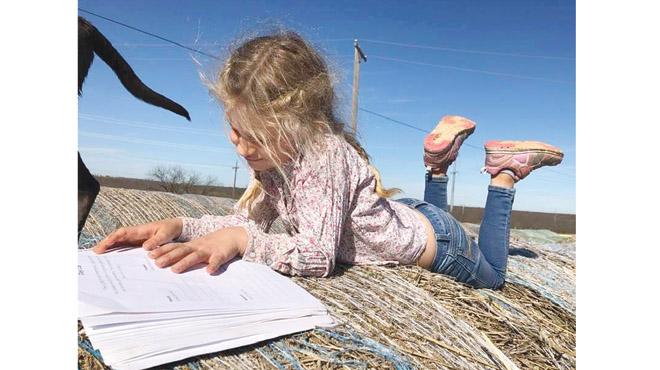
Scheduling regular breaks and taking time to do things outdoors was also a common suggestion for success.
“They have got to take breaks and get outside for some exercise in the fresh air at least once a day,” Ivy said. “We have also found that taking time off over the weekends like students do during the regular school setting is important.”
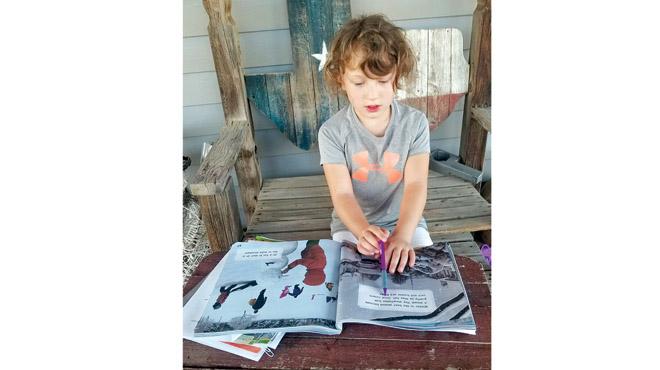
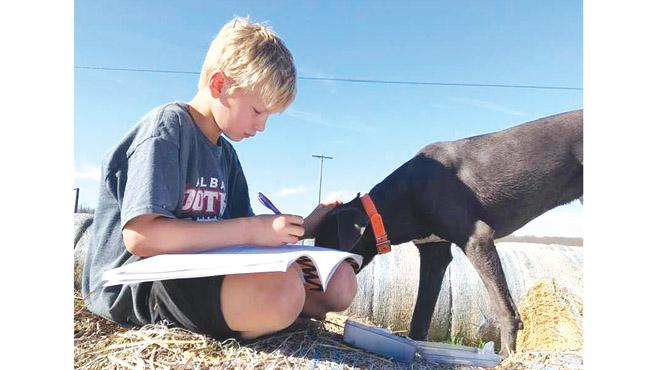
Some parents, however, have discovered that their students work faster and focus better outdoors. Michelle Alexander’s daughter Anna regularly does her homework out on the porch.
“She definitely does better outside,” said Alexander.
Albany business owner Michaela Smith has found that a morning school schedule works well for her two grade schoolers.
“We have been doing the work teachers send in the morning, and they read for about an hour after lunch,” Smith said. “Then my daughter does some math tutoring online, which she was already doing, followed by fun time.”
Later in the afternoon or evening, Smith says they take “trips” around the world. Currently the focus is on Europe.
“On Monday, Wednesday, and Friday, we pick a different country and learn to cook something from there, look at maps from the country and talk about their customs,” she said. “We just try to have fun with it.”
On Tuesday and Thursday afternoons or evening, the Smiths explore science projects, having already made slime, with plans to make paper airplanes and balloon rockets coming up next.
Local parent Alicia Burton, mother of four, has also dedicated much of her time to making the school closure special.
“We have time in the morning for school work, then we try to spend the rest of the day outside,” she said. “The kids have chores to do, but when that is finished, they go fishing, ride horses, go hiking, or play basketball.”
The family lives on a farm in Jones County.
Burton said that she is grateful that teachers at Nancy Smith Elementary have made the effort to have assignments all organized and ready to pick up once a week.
“I’m typically on the road about two hours each day, so the school closure has given me much more time at home,” she said. “I’m really enjoying the time we have been able to spend together.”
Burton echoed a recurring theme for several parents.
“While this has been a challenging situation, it has also been a blessing,” Smith said. “Having the kids at home has forced me to spend more time with them and get creative.”
Smith said that the most important aspect of the situation is how her children will remember this temporary pause in life.
“First, I want the kids to feel safe,” she said. “But I also want them to have great memories of the good times spent together as a family when they grow up and look back on this.”
Burton says that the simplicity of the time is important to her.
“Normally, we are just going everywhere at once with this game or that practice,” she said. “I have learned that we needed this slow down. The beauty of a more simple time has become precious to me. We just wouldn’t normally have had this extra time together.”
Ivy said that she was facing a spring packed with activities before the shutdown, which includes all school extracurricular activities.
“This has brought us back together to value each other as family,” she said. “We aren’t just going, going, going all the time. It has become very valuable time.”
There have been a few struggles along the way for some parents. A recent conversation on Facebook noted that parents are not necessarily proficient in all areas of instruction – especially math – which many feel had changed drastically since their time in grade school.
“The math is a big struggle for me,” said Malarie Sutton, mother of two elementary students. “It’s been 12 years since high school, and it took us about seven hours to do three packets of fourth grade math. It is definitely not a subject that is fresh on my mind.”
Sutton said her children start school work right after lunch.
“Hadley is in kindergarten, so her work only takes a few minutes,” she said. “But Hunter is in fourth grade, and he is spending a couple of hours each day.”
She also relies on outdoor activities to fill the day.
“We go on bike rides, walk, just spend as much time outside as possible,” she said. “We did the bear hunt last Saturday, and I hope someone comes up with something fun like that this weekend. Hunter has learned how to mow grass, and he’s doing his fiddle lessons over Facetime.”
Sutton said that the kids even decided to try the family swimming pool but found out quickly that it wasn’t quite warm enough for that yet.
