
Orsak brings awareness to life-long illness
By Kathy Thomson
November is Diabetic Awareness Month, and one Moran student is personally aware of dangers and hardships caused by this life-long disease.
According to the 2017 National Diabetes Statistics Report, there are 30.3 million people in the United States living with diabetes, and of those, 90 to 95 percent have type two diabetes, where their bodies do not respond correctly to insulin.
Baylee Orsak has the less common type one, where the pancreas does not make an adequate amount of insulin.
“Type one diabetics are just like everyone else,” Orsak said. “We can eat what anyone else can eat. We just get our insulin from a bottle, not a pancreas.”
That doesn’t mean that it is easy.
“We have to count the carbs of everything we eat then divide it by our carb to insulin ratio...but we can eat it,” she said. “We become excellent mathematicians.”
In spite of counting carbohydrates and figuring insulin doses, Orsak has had many low blood sugar moments.
“It’s scary to think that if I didn’t get proper treatment, or if no one was there to help me, it would’ve taken my life,” she said. “I’ve had seizures due to this, and nights where I’m too low to sleep are the worst.”
Orsak said that she worries her blood sugar could drop so low that she wouldn’t wake up in time to inject the needed insulin.
She has also come near death because of high blood sugar levels.
“Type one diabetes isn’t a joke, it’s not funny, and it’s not easy,” she said. “It’s life threatening, unpredictable, and can be deadly.”
Orsak is grateful she is not fighting alone.
“I’m so thankful for my mom who constantly checks on me throughout the day, and three or more times during the night,” Orsak said. “I’m always thankful for the family and friends who help me fight this. But lastly, I’m so blessed to have Quincee; she’s a lifesaver.”
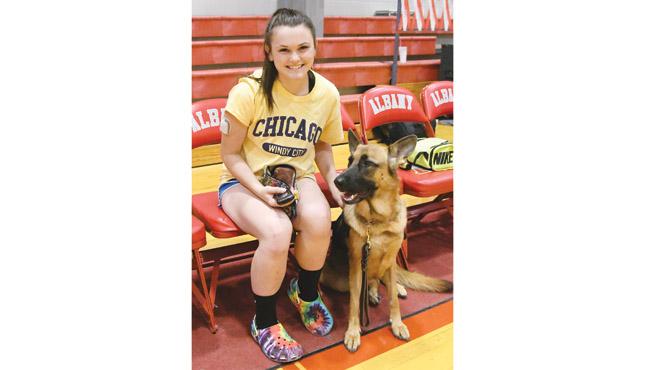
Quincee is an alert dog.
“We got her when she was three months old,” Orsak said. “She started obedience training soon after and scent work once she was 13 months old.”
Bev Swartz of All Purpose Canines in Ranger trained Quincee, who caught on quickly, according to Orsak.
“When my blood sugar starts rising or is high, Quincee starts barking,” Orsak said. “When my blood sugar gets below 80, Quincee will either paw at me (when I’m asleep) or nudge me with her nose. She is a super smart dog.”
If Quincee can’t wake Baylee up, the dog will go get her mother to come check on her.
Quincee has even alerted on another diabetic whose blood sugar was out of range.
“Quincee goes everywhere I go, including school!” Orsak said. “She has saved my life several times. I don’t know what I would do without her.”
Quincee has become such a fixture at MISD that when the photographers came to take student pictures last month, Quincee’s junior class picture was taken so it could be included in the yearbook.
Quincee can also be found with Orsak at sporting events, hanging out with friends, and wearing Bulldog gear for cheer activities.
“Sports are hard on me,” Orsak said. “I love volleyball but being active can drop my blood sugar to a very dangerous low number so I can’t participate.”
Instead, Orsak serves as the team manager.
“I also have a low immune system so I can catch anything and everything that is going around,” she said. “My mom and I feel it is very important that if you are sick, stay home. The moment you go to school, I (and people like me) have a higher chance of catching what you have. Sometimes it can put me in the hospital, even in the ICU.”
Orsak was first diagnosed with type one diabetes when she was seven.
“Luckily, my mom paid close attention to me and knew me well,” said Orsak. “She saw that I was not being as active as normal, and I was thirsty all the time, so she took me to see Dr. Jones in Graham.”
Orsak considers herself lucky that her doctor correctly diagnosed her problem.
“Some kids (and adults) are misdiagnosed, which leads to their lives being taken from them,” she said. “I’m lucky because I got the right tests done, and it was treated in the proper way. There are so many kids that are misdiagnosed and die because their doctor thinks it is the flu.”
Insulin is a treatment, but it is not a cure.
“I have to check my blood sugar by poking myself with a small needle up to eight times a day...for nine years so far..that’s 26, 280 times,” said Orsak. “All of my fingertips are calloused.”
For several years Orsak gave herself regular injections of insulin, but she now uses a pump.
“From the time I was seven until I was 14, I used syringes to give myself shots,” she said. “That’s an estimation of five shots a day for seven years..that’s almost 14,000 shots.”
Orsak helps focus attention on type one diabetes by raising money for JDRF (formerly called the Junior Diabetes Research Foundation), participating in ONE Walk, and speaking to groups about diabetes.
“I can be very sick one moment and feel better soon after, and vice versa,” Orsak said. “I can go weeks with perfect health and numbers, and there are times I can go weeks being very sick. It’s a real disease, and we never fake being sick.”
Last year, there were several days when Orsak didn’t feel good.
“I kept checking my blood sugar, and it was normal,” she said. “My mom knew it had to be wrong. We went to the office at school, checked on a different meter, and it read ‘HI’ which means I was over 600.”
Her meter wasn’t working.
“I was supposed to be able to trust that meter, and it failed,” Orsak said. “We need a cure.”
Orsak is doing what she can to help fund needed research. Meantime, Quincee, family, and friends help Orsak live as normally as possible in spite of being “the proud owner of a lazy pancreas.”
