
Local firefighters aid in flood recovery
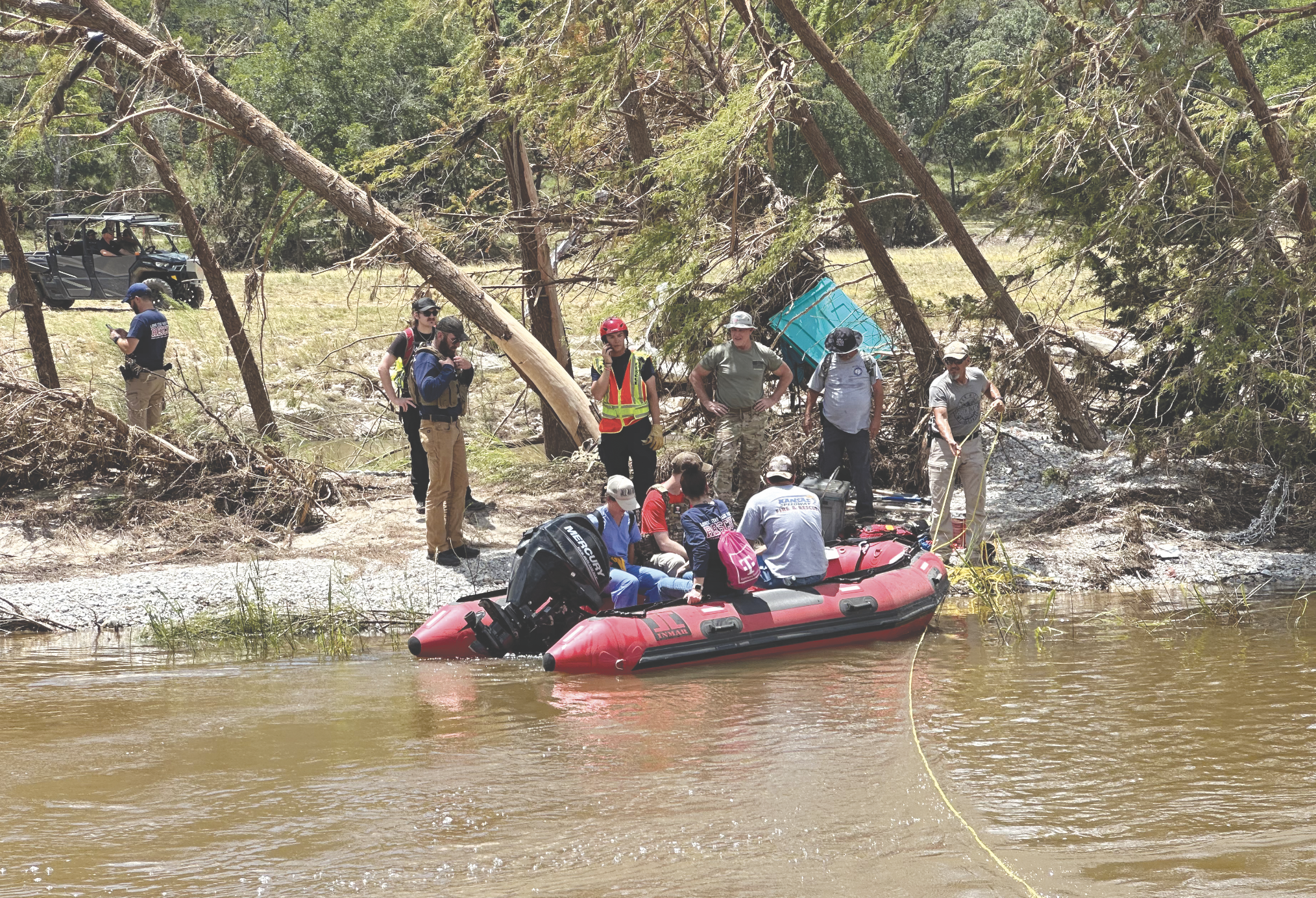
Six members of the Albany Volunteer Fire Department joined hundreds of responders in Central Texas last week, taking part in a large-scale search and recovery operation following catastrophic flooding over the July 4 weekend. Led by Albany Fire Chief Joel Viertel, the local team was deployed to assist efforts along the Guadalupe River near Ingram, where the flood left miles of debris fields and tragically claimed over 130 lives, with 160 still missing.
The call came Monday, July 7, when a fellow search and rescue leader reached out to Viertel with a request: trained, experienced personnel were needed on the ground. Viertel quickly agreed to help and began organizing a team from Albany. By Tuesday, July 8, the group was on the road.
Viertel, who has led or participated in numerous missions throughout Texas, knew the situation required more than manpower. It needed coordination, discipline, and calm under pressure. “You don’t go down there to be the hero,” he said. “You go to do your job, to serve with dignity, and to help bring peace to hurting families. That’s what matters.”
The Albany team first checked in at the Kerrville Fire Department, but the volume of volunteers had overwhelmed local officials. Rather than remain idle, they were directed to nearby Ingram, where the Fredericksburg Fire Department had assumed command of operations and implemented a structured sector-based approach along the river.
“They had it squared away,” Viertel said. “We walked in and told them we had experienced searchers. They showed us the map, pointed to Bravo Sector, and said, ‘Start there.’”
That kind of organization allowed teams like Albany’s to work efficiently, often paired with cadaver dogs and supported by heavy equipment. Massive debris piles—some more than 20 feet tall—had formed along the riverbanks and required careful excavation. “They estimated over $100 million worth of equipment on the river,” Viertel said. “And all of it was volunteered. Private operators brought in excavators, skid steers, boats—some even left the equipment and said, ‘Use it however you need.’”
The Albany crew joined efforts to clear one of the most challenging areas, including an island roughly the size of a football field. Volunteers worked in small units, often six to eight people per team, moving slowly and deliberately through brush and debris. “The goal is always to find survivors,” Viertel said. “But even if you don’t, every cleared area brings closure and allows other teams to move forward.”
As the mission evolved, Viertel was asked to lead a much larger team of more than 40 people, many of whom he had never met. Drawing from his background and past emergency deployments, he quickly organized them into workable units. That group was soon reassigned to a recovery effort near a low-water bridge, where a large debris pile had trapped at least one victim.
“We had saw crews, medics, law enforcement, and dog teams all working together,” Viertel said. “It was tight quarters, and you had to move slow. But we got the job done.”
Media presence along the river became another challenge. On several occasions, Viertel had to confront news crews who set up too close to recovery zones. “I told them, ‘You’re telling a story that needs to be told. But if you see us recover someone, shut it down. That’s somebody’s loved one,’” he said. “They were respectful after that. Most of them understood.”
The team stayed through Sunday, July 13, when flash flood warnings forced a pause in search operations. Before leaving, Viertel was asked to help organize swift water rescue teams in case new emergencies developed. Certified rescue personnel, boats, and medics were put in place while the crew waited in a holding pattern. By the end of the day, the river came down allowing the team to stand down.
The Albany group returned home late that evening, exhausted but proud of the work they had done. In addition to Viertel, the team included Travis Gardenhire, Cyrena Wooster, Casey Kimbrough, Zack Waggoner, and Thomas Gentile.
Each member brought critical skills and selflessly gave their time in a mission defined by difficult terrain, heavy emotional toll, and the sheer scale of the disaster.
“There are no small jobs in something like this,” Viertel said. “Whether you’re clearing a debris pile or keeping equipment running, it all matters. Everyone there just wanted to help. And I’m proud that Albany was part of it.”
