
The Echo: The Rise and Fall of the McLemore Hotel
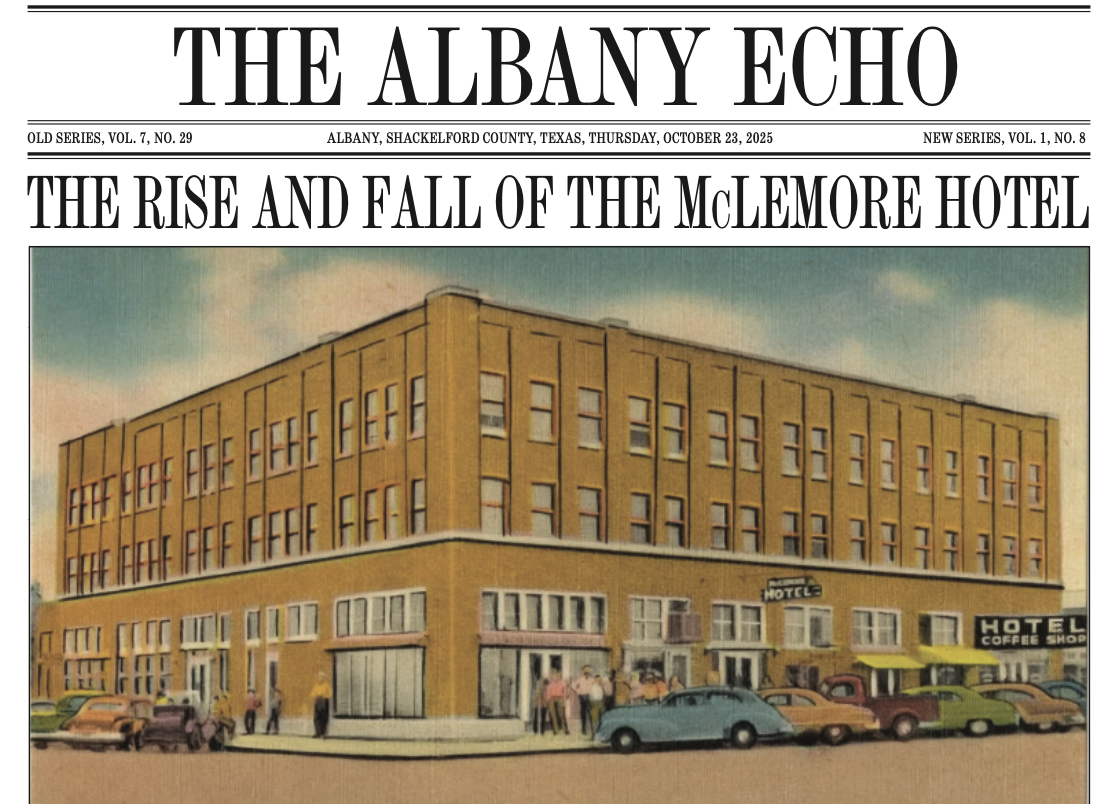
In the heart of Albany once stood a beacon of hospitality and modernity—the McLemore Hotel. Erected in 1926 by Ada McLemore, wife of Shackelford County pioneer ranchman Wade McLemore, this establishment was more than just a place to rest one’s head; it was a testament to ambition and progress in a burgeoning oil community.
Ada McLemore’s journey to hotel ownership began in 1923. Two years prior, her husband Wade passed away, and she decided to leave the ranch and relocate to Albany with her daughter, driven by a long-held aspiration to own a hotel. Eager to embark on her new venture, she purchased the Sackett Hotel, renaming it The Albany House. Despite its unassuming appearance—an odd-looking three-story wooden structure on the corner of Main and South 1st streets—McLemore saw potential, especially with the oil boom that promised a steady stream of patrons.
By 1925, McLemore set her sights on a more modern establishment. She envisioned a three-story brick hotel boasting over 40 rooms, a project estimated to cost $120,000. To finance this ambitious endeavor, McLemore liquidated her assets, including her ranch and cattle. With plans in motion, she enlisted the expertise of Abilene architect David S. Castle to design the new hotel, which would feature Albany’s first elevator.
The prime location of The Albany House made it an ideal site for the new construction. McLemore relocated the old hotel to a nearby lot and commenced construction on the new hotel. The contractor hired to build the hotel was The San Antonio Construction Company. With remarkable speed, the hotel took shape, and by the fall of 1926, the doors swung open to reveal a grand establishment with 48 rooms, 35 of which had private bathrooms, and a private residence for McLemore herself.
The grand opening banquet on December 16, 1926, was a spectacle to behold, akin to scenes from Hollywood movies. Dignitaries and guests numbering 229 dressed in their finest and filled the lobby and dining room, serenaded by music from a male quartet and orchestra. The McLemore Hotel not only provided accommodation but also housed amenities such as a coffee shop, drug store, barber shop, doctor’s office, and Western Union telegraph office, becoming a hub of activity in Albany.
Under McLemore’s ownership, the hotel flourished, but in 1943, she decided to sell the establishment and relocate to Dallas. The torch passed to Bud Martin, who leased the hotel to Charles R. Jones, prompting a rebranding to the Western Skies Hotel in the late 1940s. To mark this transformation, the Western Skies Hotel proudly displayed a large sign on the roof of the hotel that showcased the new name. Over the years, ownership changed hands several times—from owners in Dodge City to Kansas City, until finally landing with an owner from Presidio, Texas.
By 1973, the First National Bank of Albany assumed ownership of the hotel. Despite efforts to maintain its grandeur, the passage of time and continuous use took its toll, leading to a pivotal decision in 1974. Recognizing the challenges posed by ongoing wear and tear, the difficult choice was made to dismantle the hotel.
On August 22, 1974, the once-proud McLemore Hotel yielded to the wrecking ball, its towering façade giving way to progress. Its demolition marked more than just the physical end of a building; it symbolized the end of an era. Though gone, its legacy endures in the memories and stories shared by those who experienced it firsthand.
But what happened next in the McLemore’s story is something few in Albany know — because even after its demolition, the hotel never truly left town.
When the McLemore came down in 1974, the remains of the city’s largest building were given an unexpected second life. According to a report published that same week in The Albany News, much of the hotel’s brick, concrete, and tile debris was hauled through town and delivered to the Albany Golf Club.
The article, written by Albany News editor James Lenamon, captured the moment:
“After this week, the face of Albany will be altered drastically. The largest building in town is no more. The hotel met its match when a steel ball rolled into town this Sunday. The 2,500 lb. ball danced a jig all around the old structure, at times taking large chunks and bellowing out heavy clouds of dust. Large crowds of interested onlookers crowded Main Street to watch the tall crane with its ball of destruction and a large clawing loader pull away heavy pieces of concrete bricks and steel. The resting place for the historic structure will be the Albany Golf Club. A trail of red tile, brown brick, and pieces of concrete lead to hole number five at the local golf course…”
The article went on to describe how dump trucks filled a large cavity below the hill near the green—an area notorious among golfers for swallowing poorly hit shots. The hole that once frustrated golfers would soon be filled with remnants of another Albany landmark.
The revelation adds a fascinating layer of local history to the Albany Golf Club. Hole five, known for its steep incline and challenging layout, conceals beneath its surface the remnants of the McLemore Hotel. For decades, golfers have unknowingly played atop the very material that once formed one of Albany’s grandest landmarks.
The hill on hole five, infamous for its difficulty, has been the McLemore’s resting place for the last fifty years. Many golfers have found themselves coming up short on the hill over the years. To think that fifty years ago, a shot like that would have ended up in the swampy hole below must have been especially frustrating for players at the time. The hole is hard now, but that would have made it a make-or-break hole for your round. Golfers back then likely lost many more balls on that hole.
It’s poetic in a way — the grandest building in Albany’s history now lying quietly beneath the ground where golfers test their patience and skill each week.
Next time you find yourself at Albany Golf Club, take a moment at hole five to appreciate the hidden history beneath your feet. The McLemore Hotel, though no longer standing, continues to be a part of our town in a unique and unexpected way. It’s stories like these that enrich our understanding of Albany’s heritage, connecting us to the past as we enjoy the present.
