
County residents encouraged to learn difference in snakes
By Lynsi Musselman
There are probably few animal species that send shivers up spines more often than snakes, prompting many people to state emphatically that “the only good snake is a dead snake.”
Snakes are even synonymous with the devil, associated with lies, evil, and temptation.
However, snakes are not always an adversary.
According to the Texas Parks and Wildlife Department website, snakes create a balance in the ecosystem, most often acting as invasive rodent control.
Some species of snakes are not harmful and are better left alone, but knowing which ones are venomous and nonvenomous can be difficult.
TPWD Wildlife Biologist Patrick Schuze said there is no simple method to determining whether the snake is venomous at a quick glance.
“Observing a broad triangular head and vertical pupils can be misleading when trying to make a determination,” Schuze said.
Knowing which snakes occur in Shackelford County and being familiar with what each species looks like is the best way to determine if a snake is dangerous, according to the TPWD.
Some harmless snakes can act like and make themselves look like rattlesnakes. The nonvenomous Texas hognose is a good example.
Remembering a few simple tips can help when identifying which snakes are dangerous to humans.
Many nonvenomous snakes will vibrate the end of their tails, but only a rattlesnake actually has rattles that produce a “cicada-like” buzz.
Schuze said snakes commonly found in Shackelford County include Western Groundsnakes, Western Coachwhips, Great Plains Ratsnakes, Checkered Garter Snakes, Western Diamondback Rattlesnakes, and Copperheads, the latter two being venomous.
Shuze added that avoiding areas snakes typically find comfortable is the best defense against venomous snake bites.
Popular hangouts for snakes include under rocks, fallen limbs and leaf litter, as well as in and around tall grassy and bushy areas, rock piles, stacked lumber, and stone wall fences. Basking on warm rocks is also a favorite spot for reptiles.
Paying attention and being alert to one’s surroundings sounds like an obvious solution, but rattlesnakes can be hard to see in their natural habitat, and can be in unexpected places.
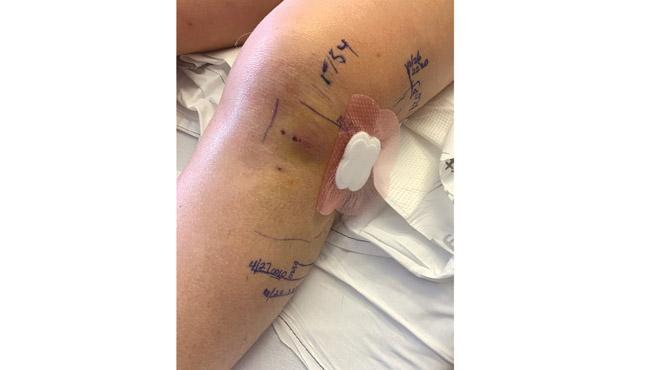
Shackelford County resident Kallee Craft suffered a rattlesnake bite to her left knee at the end of April this year.
Craft said she was at home planting flowers when she went to connect the water hose to the faucet and a rattlesnake struck her leg.
She said she was taken to meet the ambulance halfway between Ibex and Breckenridge, and then taken by ambulance to the hospital in Breckenridge where she received the first vial of anti-venom.
“Before it was all said and done, they transferred me to Hendrick Medical Center in Abilene where I spent three nights in ICU and received 46 vials of anti-venom,” Craft said.
The local resident has recovered but said she still has some pain in her left leg where she has nerve damage from the bite.
TPWD reports that snake bites are actually rare.
In Texas there are two to three deaths per year compared to five to seven deaths for insect bites and eight deaths for lightning strikes.
Schuze said learning about snakes in the area and which ones can be helpful and is a good way to understand the species and reduce the fear factor.
He said INaturalist.com is a good platform for sharing observations and seeing what other species are being seen within Shackelford County.
