
Trinity Episcopal celebrates 115 years
By Lynsi Perry
Trinity Episcopal Church of Albany, located at the top of the “T” of North 2nd and Avenue B, will celebrate its 115th anniversary as a recognized congregation of the Protestant Episcopal Church on Sunday, April 27th. Trinity was established as a frontier church 30 plus years before its official recognition from the Diocese. Parishioners met in homes and other churches prior to purchasing their current church building.
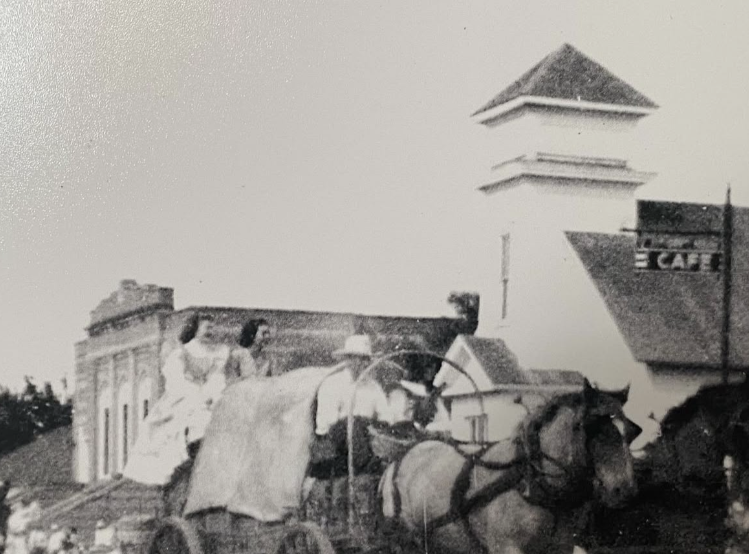
Two State of Texas Historical markers are located at the present-day church building site — one stating that the building is the oldest church building in Albany. When the Methodist organized in Albany in 1873, they built this sanctuary on Schoolhouse Hill in 1889. It was then moved to Main Street in 1909. Local Episcopalians purchased the building in 1913 for $1,000, and renovated it in 1914. It was not until 1954 that the entire building was picked up and moved up the road to where it sits today. The land was originally the home of Reynolds Presbyterian Academy, hence the second historical marker, and given to Trinity by Watt Matthews. The added steeple was designed by Floyd M. Johnson and Joe Blanton.
Noticeably, the cross atop the steeple is tilted to the left. Senior Warden of the Trinity Vestry, Larry Bell, said he wishes the cross could be straight and it has been repaired a few times but to permanently fix it will be an expensive proposition. The typical response parishioners give when asked about the crooked cross is, “Hey, we are all a bit tilted and that is why Christ came in the first place,” said Bell. How is that for symbolism?
As far back as 1889 the Episcopalians purchased a tracker pipe organ built in 1859 for St. John’s Episcopal Church in Upstate New York. The organ was brought all the way to Albany and placed in the new Christian Church building as a thank you for being allowed to worship in the Christian Church until one of their own was built. The Albany News issue of April 11, 1889 said “Now this is what we call brotherly love and the good whole souled people of Albany have set an example that should be imitated by Christians everywhere.” Still displaying a community example, this same organ is played by local talent Sandy Abel. Abel plays the organ for Trinity and then rushes down to Matthews Memorial Presbyterian Church to play their much larger organ.
It is not clear when the organ was placed where it currently resides, but there have been other additions during the “great” renovation. The church is adorned with two stained glasses made in London in 1930 for a church near York, England that was later deconsecrated, and now frame the altar of Trinity in Albany. There are two glass paneled doors that were once in an English Pub but now separate the vestibule from the nave. The pendant cross, pulpit, and prayer stall all have significance and are treasured by not only parishioners but historians.
Bell adds the building is also the second oldest wood frame structure in Albany, as well as the smallest church building. However, the size of the building has never been a problem for the congregation. The membership swelled to 15 to 20 members about 25 years ago. Bell explained that as the old timers started dying off or members moved, the numbers decreased. Then when long time member and last of the old timers, John Matthews passed in 2020, the church became vulnerable. Bell said Trinity has pressed on and having Doctor Doug Thomas serve as the Vicar for Trinity has been a great help. “Our congregation has always been comparatively small, but it is still alive and well in service to our Lord,” added Bell.
Trinity is served by a Vicar, who is for a small Episcopal Church versus a rector who is the priest at a large Episcopal Church. Thomas not only serves Trinity but is the Priest in Residence at the Episcopal Church of the Heavenly Rest in Abilene. Bell mentioned that both Heavenly Rest and St. Mark’s Episcopal in Abilene have always been helpful and cooperative to the congregation in Albany. The Episcopal churches in Abilene, along with Trinity, all belong to the Diocese of Northwest Texas and share a bishop.
The Protestant Episcopal Church in the United States received its foundation from the Church of England, evolving to being governed by bishops sometime around the American Revolution, and then being practiced in Albany about the time the courthouse was built in 1883. Established as a frontier church, Trinity’s values remain true to independence and adaptability, while working cooperatively with all their neighbors and celebrating each time they gather as a community.
Bell adds that Trinity has always had an ecumenical background. Not only did the Methodists build the church, but the Baptist held Sunday School classes in it when it was located on Main Street. Today there is not one “cradle” Episcoal attending Trinity. They are all rooted in different Christian denominations ranging from Presbyterian, Church of Christ, and Catholic. The vicar is the son of a Baptist preacher, who taught at Hardin Simmons and went to Baptist Seminary.
Trinity’s mission is to serve Christ by welcoming His children in all their diversity. They hope all will come to visit on Sunday and celebrate the 115th anniversary of this congregation and some of Albany’s history, as well as keeping the tradition alive of supporting congregational fellowship.
Trinity regularly meets the second and fourth Sundays of the month at 9:45 a.m., at 140 North Avenue B. For more information, visit their website at www.trinityepiscopalchurch.dionwt.org.
