
Cook Field discovery marks a century
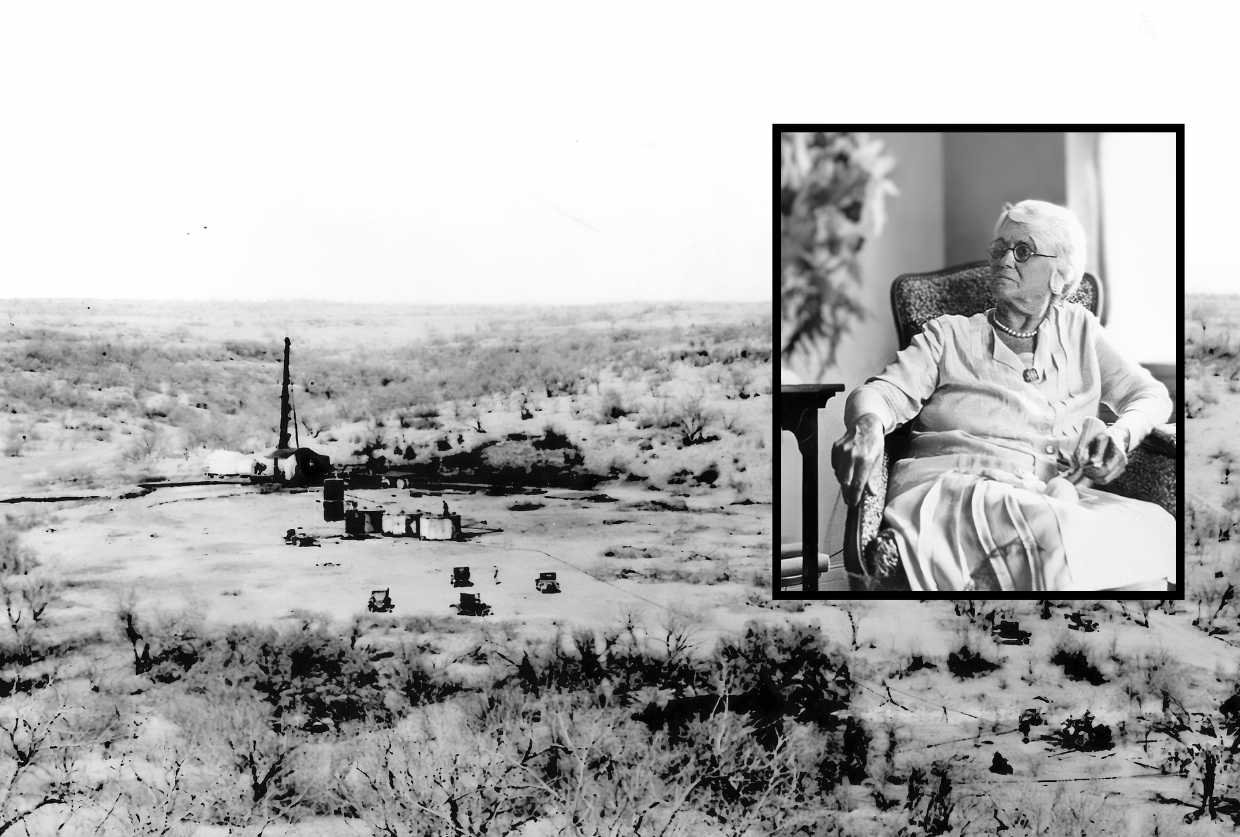
Last week marked 100 years since a moment that forever changed the course of Shackelford County history.
On Feb. 18, 1926, an oil well drilled on the Cook Ranch five miles northwest of Albany erupted with a gusher that would soon become known around the world. What followed was not only an economic transformation that reshaped Albany and the surrounding region, but a legacy that would extend far beyond oil production — one that continues to impact lives today.
In the century since that discovery, the Cook Oil Field has produced millions of barrels of oil, provided livelihoods for generations of local families, and funded one of the most respected pediatric healthcare systems in the nation.
It remains, by nearly any measure, the most significant single event in the history of Shackelford County
To understand how it happened, one must go back to a quiet ranch purchase decades before the discovery — and to a woman whose vision and perseverance would ultimately change countless lives.
A rancher’s
gamble
In 1897, Missouri Matilda Nail Cook and her brother, Jim Nail, purchased nearly 18,000 acres of land in Shackelford County from the Holstein family. Over the next several years, the holdings were expanded until the ranch eventually totaled nearly 19,500 acres.
At the time, the land was considered marginal for ranching. Water was scarce, and its value seemed limited. That perception was reinforced in 1899 when Matilda’s brother, James H. Nail Sr., attempted to buy out her interest in the property.
Instead of selling, Matilda made a decision that would prove historic — she purchased her brother’s share of the ranch herself.
Family members later recalled that he remarked he had sold her “the sorriest piece of land in Shackelford County.” What no one yet realized was that beneath the surface lay a resource that would one day transform the region.
Tragedy that
shaped a vision
Despite the promise of the ranch, Matilda Cook’s life was marked by profound personal loss.
In 1901, her only child, Jesse Cook, died during childbirth, along with Jesse’s newborn son. The tragedy left a lasting impact on Mrs. Cook, who became determined that better medical care should be available for women and children.
More than two decades later, in 1923, she suffered another devastating loss when her husband died, leaving her to manage the ranch alone.
Though grief defined much of her personal life, those tragedies would later shape one of the most enduring philanthropic legacies in Texas history.
The last roll
of the dice
By the mid-1920s, several oil companies had already explored the Cook Ranch with little success. Multiple wells had been drilled on the property, and each had come up dry. Most observers believed the land held little promise for oil production.
In 1925, independent oilmen Charles F. Roeser and Marshall R. Young, who had been partners in oil ventures since 1919, along with Tolbert Pendleton, approached Mrs. Cook seeking leases to drill on the ranch. The three men were operating as partners under the name Roeser & Pendleton.
Their company had endured a series of setbacks and was running dangerously low on money after drilling several unsuccessful wells.
Even Mrs. Cook and her family were skeptical. They provided the oilmen with reports from earlier dry holes drilled on the property and made it clear that the chances of success appeared slim. Despite those discouraging results, Roeser remained convinced that oil could still be found beneath the ranch, relying heavily on the confidence of his geologist.
With leases secured, the company selected a drilling location on ETRR Section 85 and began moving equipment to the site. But their financial situation had become so precarious that this effort represented what was essentially their final attempt before being forced out of the oil business.
As their drilling rig was being hauled to the planned location, the truck transporting the equipment broke down. Repairs were attempted, but the truck failed again. At that point, the company had no money remaining to make further repairs or to continue transporting the rig to its original destination.
Faced with the prospect of complete financial collapse, Roeser made a decision that would become one of the most famous moments in the history of the West Texas oil industry.
Rather than abandon the project, he ordered the crew to drill at the spot where the equipment sat, even though it was not the intended location. It was, in effect, a desperate last effort — a decision made because there was nothing left to lose.
Drilling began on Jan. 1, 1926. Weeks later, on Feb. 18, at a depth of roughly 1,240 feet, the well struck oil.
The gamble had succeeded.
What began as a near-failure born out of financial desperation became the discovery of what was then the largest shallow oil pool in the world — a discovery that would transform not only the fortunes of those involved, but the future of Shackelford County itself.
The gusher that
put Albany on the map
Once oil was discovered, development of the Cook Field accelerated rapidly. Hundreds of workers poured into the area, and drilling expanded across the ranch. Within a year of the discovery, Roeser and Pendleton constructed Cook Camp, a small community of about 20 houses, while a large tent city sprang up across the Cook Field Road to accommodate the growing workforce. At its peak, between 1,250 and 2,000 men were employed in drilling and production operations across the field. By December 1926, more than 100 wells were producing nearly 265,000 barrels of oil per month.
Within three years, the field was producing approximately 10,000 barrels of oil daily.
Behind that rapid expansion stood a group of determined oilmen and skilled workers whose efforts turned a single discovery well into one of the most productive shallow oil fields in the world.
One of the key figures in the field’s development was Marshall R. Young, an independent oil producer who played a central role in expanding operations after the discovery. A mechanical innovator in drilling operations, Young later took a leading role in managing and growing production through what became the Marshall R. Young Oil Company. His work helped establish efficient drilling and conservation practices that would later be studied by petroleum engineers across the country.
The field’s success, however, was not solely the result of company leadership. It depended on hundreds of local workers who drilled wells, operated gasoline plants, maintained equipment, and managed daily production activities. Many of these men were residents of Albany and surrounding communities, and their labor helped sustain the field for decades.
Families across Shackelford County found steady employment in oil-related work, from drilling crews and field operators to maintenance staff and office personnel. The development of production facilities, warehouses, and processing plants created a lasting economic foundation that supported the region through much of the 20th century.
The Cook Field quickly became a defining part of Albany’s identity and a major chapter in the history of the West Texas oil industry.
More than oil —
a legacy of compassion
For Mrs. Cook, the discovery of oil was never simply a matter of wealth or success.
For decades, she had carried the grief of losing her only child, Jesse, and her infant grandson during childbirth in 1901. The tragedy left a lasting mark on her life and shaped a quiet but determined vision: that other families should never have to endure such loss because of inadequate medical care.
When oil began flowing from the Cook Ranch in 1926, Mrs. Cook saw an opportunity to transform that vision into reality.
Within just five months of the discovery well coming in, she established the W.I. Cook Memorial Trust, dedicating a large share of her oil income to the creation of a hospital in Fort Worth. The facility would be built in memory of her late husband, William Ivy Cook, and their daughter Jesse.
Her commitment was extraordinary. Mrs. Cook initially endowed the trust with a donation of $300,000 and directed 100 percent of her oil royalties to the project until an additional $300,000 had been generated. After that goal was reached, she continued to fund the hospital by contributing one-half of her ongoing royalties to support its operation and future growth.
The W.I. Cook Memorial Hospital opened its doors on Jan. 29, 1929. Designed in an Italian Renaissance architectural style and initially equipped with 55 beds, the hospital was intended to serve working women and children in need of quality medical care.
Over time, its mission evolved in response to the region’s changing needs. By 1952, amid the nationwide polio epidemic, the hospital shifted its focus exclusively to pediatric care and became known as Cook Children’s Hospital.
Decades later, it would merge with another Fort Worth facility to form what is now Cook Children’s Medical Center, one of the nation’s most respected pediatric healthcare systems.
Even today, a century after the Cook Field discovery, royalties from the Cook Ranch continue to help fund the hospital’s operations, ensuring that Mrs. Cook’s vision remains alive.
Her legacy stands as one of the most remarkable examples of philanthropy in Texas history — a story in which personal tragedy, transformed by faith and generosity, ultimately created a lasting source of hope and healing for countless children and families.
A century
later
Even after 100 years, the legacy of the Cook Field remains visible across Shackelford County.
The field continues to produce oil, though at far lower levels than during its peak. More importantly, its impact on the community endures in ways that extend far beyond economics.
The discovery brought prosperity to Albany, shaped generations of local families, and created a philanthropic legacy that continues to benefit children across Texas.
What began with a broken truck and a desperate gamble became a defining moment in the county’s history — one that transformed both a community and countless lives.
As Shackelford County marks the centennial of the Cook Field discovery this week, the event stands as a powerful reminder that even the most unlikely circumstances can lead to extraordinary outcomes.
A century later, the story of the Cook Ranch, the oil beneath it, and the legacy it created remains one of the most remarkable chapters in the history of Albany, Shackelford County and even the United States.
